U.S. GLOBEC Georges Bank Program
The U.S. GLOBEC Georges Bank Program is a large multi-
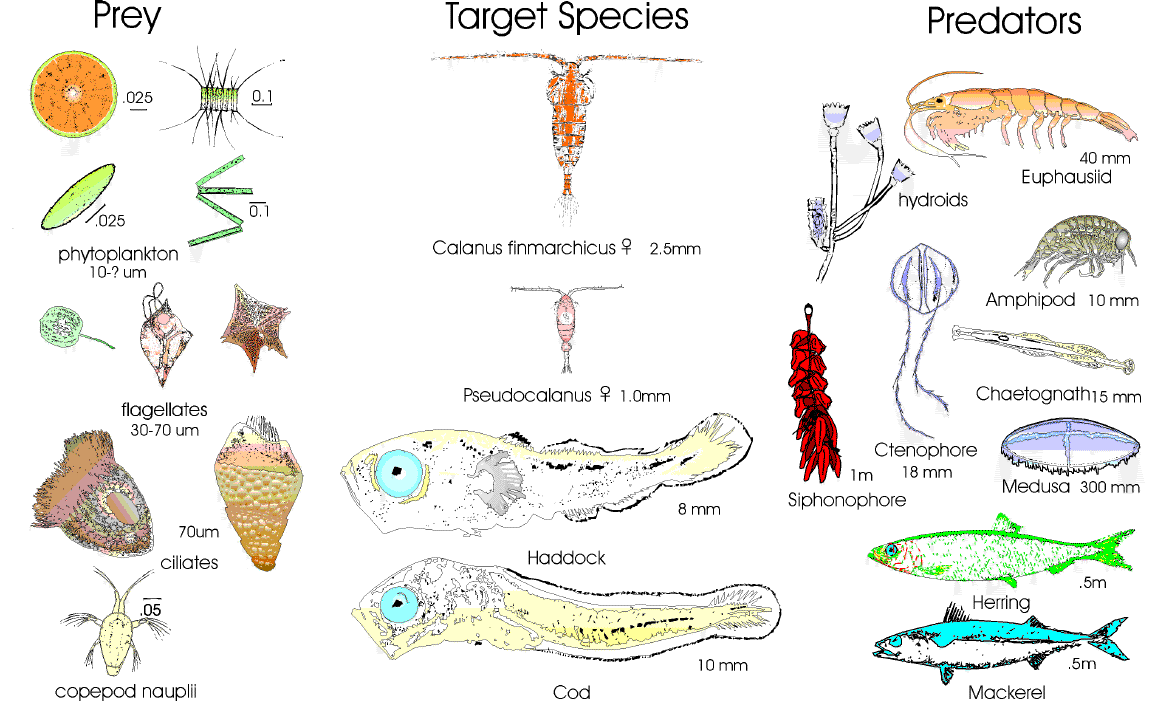
disciplinary multi-year oceanographic effort. The proximate
goal is to understand the population dynamics of key species on
the Bank -
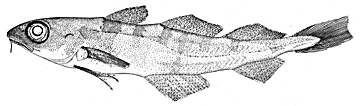
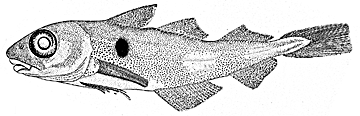
Cod,
Haddock,
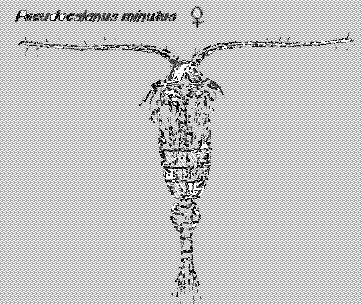
and two species of zooplankton
(Calanus finmarchicus
and
Pseudocalanus) - in
terms of their coupling to the physical environment and in terms
of their
predators and prey. The ultimate
goal is to be able to
predict changes in the distribution and abundance of these
species as a result of changes in their physical and biotic
environment as well as to anticipate how their populations might
respond to climate change.
The effort is substantial, requiring broad-scale surveys of
the entire Bank, and process studies which focus both on the
links between the target species and their physical environment,
and
the determination of fundamental aspects of these species' life
history (birth rates, growth rates, death rates, etc).
Equally important are the modelling efforts that are ongoing
which seek to provide realistic predictions of the flow field and
which utilize the life history information to produce an
integrated view of the dynamics of the populations.
The U.S. GLOBEC Georges Bank Executive
Committee (EXCO) provides program leadership and effective
communication with the funding agencies.
There are three types of cruises collecting the necessary
data: broad-scale, process and mooring.
Broad-scale
Broad-scale cruises will carry out CTD (Salinity, Temperature
and Depth), zooplankton, fish larval, and acoustic surveys of
Georges Bank and adjacent waters. On each survey cruise
50-60 stations will be occupied, with approximately 40 of these
located to provide a uniform, bank wide coverage, and the rest
of the stations located to provide a more intensive coverage in
the region of the bank where larval cod and haddock are found.
Appendix 3 is a map showing the basic stations while Appendix
4 is the positions (latitude/longitude pairs) for these stations. At
all 50-60 stations, a double Bongo tow, a CTD cast and a
MOCNESS-1 (Multiple Opening/Closing Net Environmental
Sensing System) tow will be done. At approximately 15 of the
basic stations, a plankton pump and 10-m MOCNESS will also
be deployed.
Process
Process cruises are designed to measure vital physiological rates
of zooplankton and fish larvae, and to determine fine-scale
vertical and horizontal distribution of zooplankton on Georges
Bank . The general approach will be to deploy GPS/ARGOS
drifters at sites in different hydrographic regimes on the bank
and to follow each drifter for 24 to 72 hours. Copepod egg
laying, feeding, and growth rates, and larval fish (cod) feeding
rates will be measured experimentally on board ship.
Zooplankton at these stations will be sampled in a variety of
ways, including pump, MOCNESS-1, VPR (Video Plankton
Recorder) and TAPS (Tracor Acoustic Profiling System, a
multi-frequency acoustic system that is lowered with the CTD).
Microzooplankton will be sampled with Goflo Bottles.
Hydrography, and zooplankton abundance, distribution, stage
frequency distribution, and condition will be measured at
stations between the drifter stations and along selected transects.
The VPR on Jason will focus on studies of zooplankton
behavior and distribution in different hydrographic regimes on
the bank.
Mooring
Mooring cruises both set and retrieve the long term moorings.
Mooring locations are identified in Appendix 4. These
moorings collect Vector velocity (VACM) at two heights - 15m
and 45m. Temperature data are collected at 1, 5, 10, 15, 20, 25,
30, 35, 40, and 45m combinations of VACM, SeaCats, and
Branker t-probes with hourly averages. Salinity sensors are at
1, 10, 20, 30, and 40m, using Seabird SeaCats at 2 Hz. During
these cruises, hydrographic sections with a CTD will be made.
Additional Data
The data collected at sea are analyzed along with other available
data such as satellite sea surface temperature images derived
from full (1 km) resolution AVHRR satellite data for all of
Georges Bank and the Gulf of Maine. Also analyzed are
spatially averaged CZCS pigment images derived from full (1
km) resolution CZCS and SeaWiFS satellite data for all of
Georges Bank and the Gulf of Maine.
Last modified: December 12, 1996