 at time
t. The age-stage distribution evolves according to
at time
t. The age-stage distribution evolves according toBiological models of the life-cycle of an organism or of many interacting species are often complex with large numbers of variables, and, therefore, cannot be incorporated into a full two- or three-dimensional model of a oceanic region. This paper presents a technique for reducing the complexity of such a model (using as an example, the model of Davis, 1984, for the life cycle of the copepod Pseudocalanus), while retaining the essential aspects. The full model is run in a system with no spatial variation, but with forcing representing the expected influence and time scales of the physical forcing. From this calculation, the Empirical Orthogonal Functions (EOF's), representing the principal temporal and age-stage variability, are extracted and a small set of the age-stage EOF's are used as basis functions. Simplified dynamics are derived by projecting the original dynamical system onto this set of basis functions.
Mathematically, the procedure can be expressed using an example:
suppose we begin with a zero-dimensional model for the age-stage
structure (represented as a vector at time
t. The age-stage distribution evolves according to

where r is the exchange rate with the
exterior and  is the external population
(specified). From this, we build up a matrix
is the external population
(specified). From this, we build up a matrix  of
age-stage X time. To represent this with EOF's, we find two matrices
of
age-stage X time. To represent this with EOF's, we find two matrices
 (age-stage X EOF number) and
  (EOF number X time) such that the product optimally fits . We then use the
vectors in as a new basis function and project the
dynamics, approximating by
(EOF number X time) such that the product optimally fits . We then use the
vectors in as a new basis function and project the
dynamics, approximating by  where the order of is the number
of EOF's retained, rather than the much larger number of age-stage
classes. The EOF amplitudes evolve according to
where the order of is the number
of EOF's retained, rather than the much larger number of age-stage
classes. The EOF amplitudes evolve according to

which is the same form as the original model, but reduced in dimension.
We examine development of an initial pulse, flow over one- and two-dimensional topography, and nonlinear interactions with a food source. In all these problems, the full 200 variable system can be adequately reproduced using between 5 and 15 modes (Figure 1). The reduced models are generally much more accurate than a "grouped" model (e.g., an Eggs- Nauplii- Copepodid- Adult representation). A second advantage is that the EOF reduction does not have adjustable parameters (other than the number of modes to include). The EOF approach allows the important aspects of detailed biological interactions (i.e., more realism) to be included in a large-scale physical model.
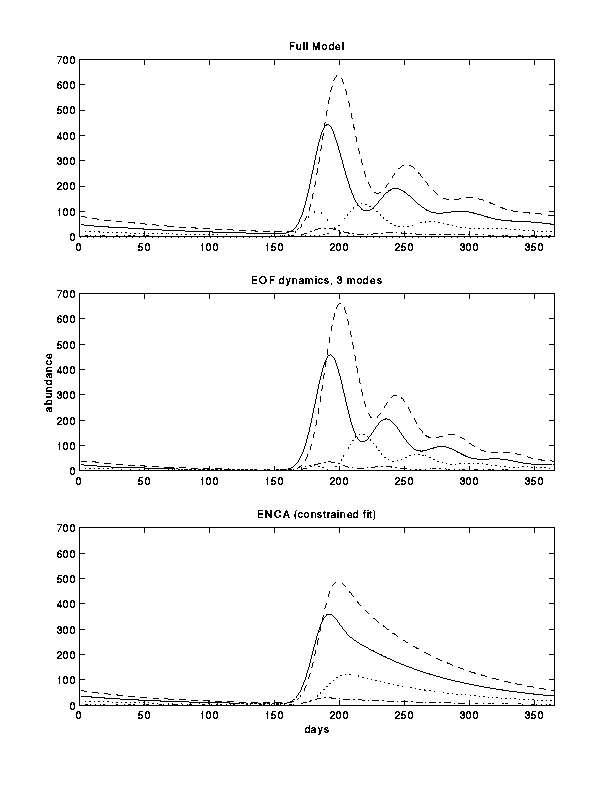
Figure 1: Population structure resulting from a yearly pulse in the external population calculated with various models. The lines show the number of Eggs (solid), Nauplii (dash), Copepodids (dot) and Adult females (dash-dot). The heavy dots show the external adult population versus time (multiplied by 100).