|
|
|
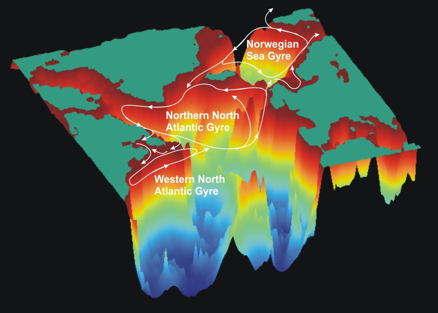
First I’d like to talk
about 3-gyre hypothesis. N. Atlantic is conceptually partitioned into three
semi-distinct gyre systems:
|
|
|
|
1) The relatively small
Western North Atlantic Gyre is located on the southernmost region of the
North Atlantic, including the Gulf of Maine, Nova Scotia, Newfoundland and
Gulf of St Lawrence.
|
|
|
|
2) The northern North
Atlantic gyre is the largest gyre system and is bounded by the
Labrador and Irminger Seas to the west, with Greenland, Iceland, and the
Faroe-Shetland Channel to the north.
|
|
|
|
3) Most northerly located is
the Norwegian Sea gyre, including the North Sea shelf, the Norwegian shelf
and fjords, and the Barents Sea.
|
|
|
|
There is a relatively
small exchange of water between northern N. Atlantic and Norwegian Sea gyres.
The large scale gyre circulation patterns may
be sufficient to partially isolate geographic populations. Therefore, Zooplankton
entrained in these gyres may be ecologically, reproductively, and (perhaps)
genetically distinct. Previous population genetic studies have also shown
some degree of genetic differentiation based on……
|
|
|