Data Sharing and Data Quality of Ocean Currents and Temperature: Towards an Operational Data Management System for the Southeast Region
Document Actions


What • Agenda • Notes and Presentations • Participants | ||
What
The main goal
for this two-day workshop was to discuss data sharing, translation, and
quality assurance of ocean currents and ocean temperature in context of
a Regional Assocation (RA). The focus
will be on data formats, processes, and tools to share data. A
secondary focus was on assuring data quality. These data are from a
variety of different sensors and dynamic ocean models providing near,
realtime data and forecasts for
comparison. Sharing data to visualize the 4-dimensional (lat, lon,
depth, and time) temperature and velocity structure is one primary goal
of ocean observing systems. Ocean current and
temperature sensors are deployed on many types of platforms, from
remote
sensors such as HF Radar, satellite temperature radiometers to in situ sensors
such as buoy-mounted current meters, acoustic current profilers,
drifters and CTDs. Favorable attempts at sharing and displaying
surface data changing with time have already been done with GIS
software. Visualization of data with depth (or altitude) proves
to be the next big hurdle in data sharing and translation. We chose to focus on ocean currents because not very
many national sources provide realtime currents but many small groups
do. The coordination of many would provide incredible coverage
and information about ocean dynamics for many uses (SAR,
transportation, etc). In addition, ocean temperature is a fairly easy
parameter with well-established formats and standards.
Incorporating ocean temperature allows
further application for fisheries management, such as obtaining views
and forecasts of bottom water temperature. Many
smaller groups do not want to reformat data to share
data. In this workshop, we are asking that all participants share their
data formats (netCDF, GIS shapefiles, images, flat ASCII, RDB, or
whatever). These various formats will provide the basis to
discuss and determine at this workshop the required properties and
processes to
translate either on-the-fly for individuals or for aggregration within
the regional context. Translation raises the issue of data quality.
Who is responsible for assuring the data are of good quality? The
regional aggregration or the individual data provider? At this
workshop, we will discuss and determine best practices for both. For
example, certain tests may be required of the provider while subsequent
checks are made by the RA upon aggregration. We will
build upon and present latest standards and practices being established
by QARTOD and DMAC. This two-day workshop was for oceanographic data managers and database administrators and computer geeks who process and handle near, realtime oceanographic data and model output on a regular basis. This workshop was part of a larger effort to move towards building data management infrastructure for the future Southeast Coastal Ocean Observing Regional Association (SECOORA). This event is hosted by the Data Management Coordinating Committee (DMCC) of the SouthEast Atlantic Coastal Ocean Observing System (SEACOOS). SECOORA funded travel, hotel, food, and workshop fee for 50 participants.
| ||
Meeting Location and Facilities
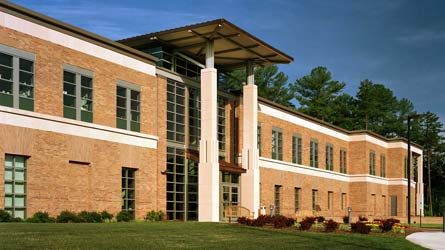
The meeting was held in Chapel Hill, North Carolina at the University of North Carolina (UNC) Center for School Leadership Development (CSLD-UNC)
on March 9-10, 2006 (Thursday and Friday) in Room 111.
| ||
Participants
Woods Hole Oceanographic Institution, MA Aida Alvera Azcarate University of South Florida, FL Steven Anderson Horizon Marine, Inc., MA Alfredo Aretxabaleta University of North Carolina, NC William S. Arnold Florida Wildlife Commisson, Fish and Wildlife Research Institute, FL Brenda Babin Louisiana Universities Marine Consortium, LA Alexander Barth University of South Florida, FL Enils Bashi NOAA Chesapeake Bay Office, MD Luis Bermudez Monterey Bay Aquarium Research Institute, CA Fred Bingham University of North Carolina at Wilmington, NC Brian Blanton University of North Carolina, NC Jennifer Bowen Scripps Institution of Oceanography, CA Steven Browdy OMSTech, FL Mark Bushnell NOAA National Ocean Service, Chris Calloway University of North Carolina, NC Grace Cartwright Virginia Institute of Marine Science, VA Jesse Cleary University of North Carolina, NC Dona Cote Texas A&M University, TX Jeremy Cothran University of South Carolina, SC Scott Cross NOAA/NESDIS/NCDDC, SC Richard Crout National Data Buoy Center, MS Jeff Donovan University of South Florida, FL Dana Dowdy Hollings Marine Lab/Oceans and Human Health, SC Bob Flemming GoMOOS/University of Maine, Orono, ME David Forrest Virgi nia Institute of Marine Science, VA Janet Fredericks Woods Hole Oceanographic Institution, MA Sherryl Gilbert USF-Alliance for Coastal Technologies, FL Hanna Habashy Baruch institute, SC Sara Haines University of North Carolina, NC Peter Hamilton Science Applications International Corporation, NC Andrea Hardy NOAA National Ocean Service, MD Douglas Hawkins INCOGEN, Inc., VA Matthew Howard Texas A&M University, TX Stephan Howden University of Sourthern Mississippi, MS Eoin Howlett Applied Science Associates, Inc., RI Jeff Jefferson University of South Carolina, SC Monisha Kanoth University of South Carolina, SC Jerome King Aquatic Farms for NOAA-NMFS, WA Josh Kohut Rutgers University, NJ Hu Lei Dauphin Island Sea Lab, AL Sage Lichtenwalner Rutgers University, NJ Parker Lumpkin SEACOOS/SECOORA, SC Daniel Martin NOAA Coastal Services Center, MA Melanie Meaux SSAI for NASA Global Change Master Directory, VA Cliff Merz University of South Florida, FL Jason Miller INCOGEN, Inc., VA Christopher Mooers University of Miami, Rosentiel School, FL Trent Moore Skidaway Institute of Oceanography, GA Robert Netsch US Coast Guard C2CEN, VA Kathleen O'Keife Fish and Wildlife Research Institute, FL Roland Owens NOAA Chesapeake Bay Office at VIMS, VA Dwayne Porter University of South Carolina, SC Robert Raye Shell International Exploration and Production Inc., TX Paul Reuter Scripps Institution of Oceanography, CA Peter Rubec Fish and Wildlife Research Institute, FL Payne Seal University of South Carolina, SC Harvey Seim University of North Carolina, NC Chris Simoniello Sea Grant Extension Program, University of South Florida, FL Matt Smith University of Alabama in Huntsville, AL Colton Smith Skidaway Institute of Oceanography, GA Jessica Stephen South Carolina Department of Natural Resources, SC Vembu Subramanian University of South Florida, FL Walter Tenney University of North Carolina at Wilmington, NC John Ulmer PSGS for NOAA Coastal Services Center, SC Pat Welsh University of North Florida CCEC, FL Lauren Wetzell Teledyne RD Instruments, CA David White NOAA Hollings Marine Lab, SC Liz Williams University of Miami, Rosentiel School, FL Nancy Wilson Virginia Institute of Marine Science, VA Total Registered: 69 |