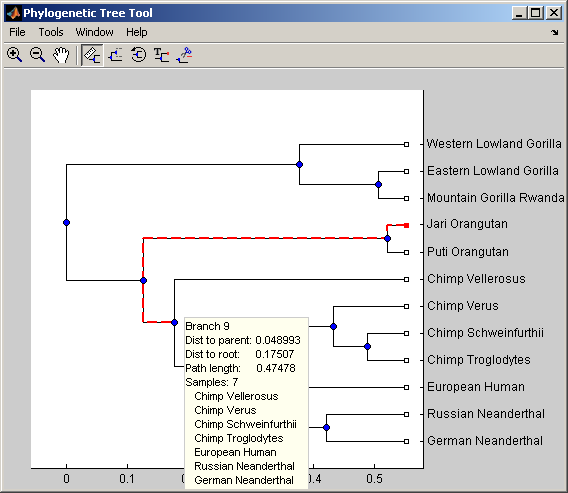
A phylogenetic tree is constructed from mtDNA sequences for the Hominidae taxa (also known as pongidae). This family embraces the gorillas, chimpanzees, orangutans and the humans.
The mitochondrial D-loop is one of the fastest mutating sequence regions in animal DNA. Therefore, useful for comparing closely related organisms. The origin of modern man is a highly debated issue that has recently been tackled by using mtDNA sequences. The limited genetic variability of human mtDNA has been explained in terms of a recent common genetic ancestry, thus implying that all modern-population mtDNAs originated from a single woman who lived in Africa less than 200,000 years.
References: "Molecular analysis of Neanderthal DNA from the northern Caucasus" Nature 404 (6777), 490-493 (2000), "Genes and languages in Europe: an analysis of mitochondrial lineages" Genome Res. 5 (1), 42-52 (1995), "Neandertal DNA sequences and the origin of modern humans" Cell 90 (1), 19-30 (1997), "Mitochondrial DNA variation and biogeography of eastern gorillas" Mol. Ecol. 10 (9), 2241-2247 (2001)
Get some data from GenBank, these are the accession codes for mitochondrial D-loop sequences that have been isolated for different hominidae species.
%          Description            Accession ID
data = {'German_Neanderthal'      'AF011222';
        'Russian_Neanderthal'     'AF254446';
        'European_Human'          'X90314'  ;
        'Mountain_Gorilla_Rwanda' 'AF089820';
        'Chimp_Troglodytes'       'AF176766';
       };

for ind = 1:5
    primates(ind).Header   = data{ind,1};
    primates(ind).Sequence = getgenbank(data{ind,2},'sequenceonly','true');
end
If you don't have a live web connection, you can load the data from a MAT-file using the command
%load primatesdemodata % <== Uncomment this if no Internet connection
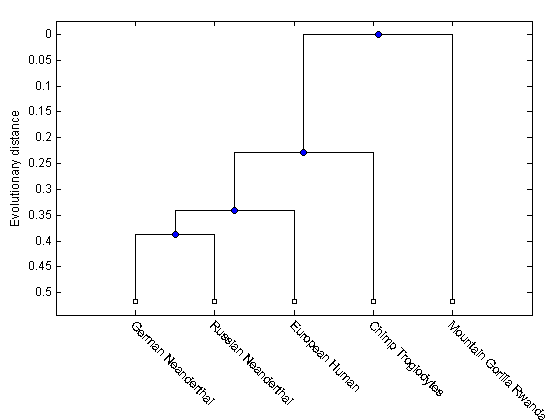
Compute pairwise distances using the 'Jukes-Cantor' formula and the phylogenetic tree with the 'UPGMA' distance method. Since the sequences are not pre-aligned, seqpdist will pairwise align them before computing the distances.
distances = seqpdist(primates(1:5),'Method','Jukes-Cantor','Alpha','DNA');
tree = seqlinkage(distances,'UPGMA',primates(1:5))
Phylogenetic tree object with 5 leaves (4 branches)
Render the phylogenetic tree
h = plot(tree,'orient','bottom');
ylabel('Evolutionary distance')
set(h.terminalNodeLabels,'Rotation',-45)
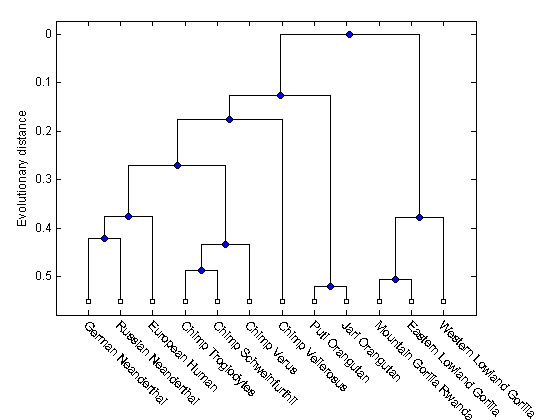
Scale our experiment up by including some more mtDNA sequences. We also get them from GeneBank.
%          Description            Accession ID
data2 = {'Puti_Orangutan'          'AF451972';
         'Jari_Orangutan'          'AF451964';
         'Western_Lowland_Gorilla' 'AY079510';
         'Eastern_Lowland_Gorilla' 'AF050738';
         'Chimp_Schweinfurthii'    'AF176722';
         'Chimp_Vellerosus'        'AF315498';
         'Chimp_Verus'             'AF176731';
       };

for ind = 1:7
    primates(ind+5).Header   = data2{ind,1};
    primates(ind+5).Sequence = getgenbank(data2{ind,2},'sequenceonly','true');
end
Compute pairwise distances and the hierarchical linkage.
distances = seqpdist(primates,'Method','Jukes-Cantor','Alpha','DNA');
tree = seqlinkage(distances,'UPGMA',primates);
Render the phylogenetic tree
h = plot(tree,'orient','bottom');
ylabel('Evolutionary distance')
set(h.terminalNodeLabels,'Rotation',-45)
Find the closet species to the 'European Human' entry (3).
names = get(tree,'LeafNames')
[h_all,h_leaves] = select(tree,'reference',3,'criteria','distance','threshold',0.6);
% h_all has now all the nodes within 0.6 of patristic distance to the 'European
% Human' leave.
% h_leaves has only the leaf nodes within 0.6 of patristic distance to (3)
subtree_names = names(h_leaves)
names =
    'German_Neanderthal'
    'Russian_Neanderthal'
    'European_Human'
    'Chimp_Troglodytes'
    'Chimp_Schweinfurthii'
    'Chimp_Verus'
    'Chimp_Vellerosus'
    'Puti_Orangutan'
    'Jari_Orangutan'
    'Mountain_Gorilla_Rwanda'
    'Eastern_Lowland_Gorilla'
    'Western_Lowland_Gorilla'
subtree_names =
    'German_Neanderthal'
    'Russian_Neanderthal'
    'European_Human'
    'Chimp_Troglodytes'
    'Chimp_Schweinfurthii'
    'Chimp_Verus'
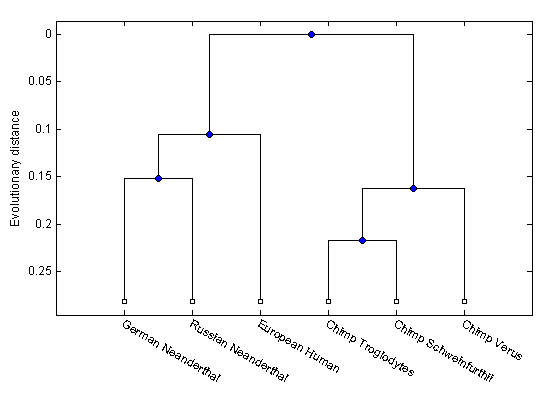
Reduce the tree to the sub-branch of interest
leaves_to_prune = ~h_leaves;
pruned_tree = prune(tree,leaves_to_prune)
h = plot(pruned_tree,'orient','bottom');
ylabel('Evolutionary distance')
set(h.terminalNodeLabels,'Rotation',-30)
Phylogenetic tree object with 6 leaves (5 branches)
With view you can further explore/edit the phylogenetic tree using an interactive tool. See also phytreetool.
view(tree,h_leaves)