You can convert any LTI model to transfer function, zero-pole-gain, or state-space form using the commands TF, ZPK, and SS, respectively. For example, given a two-input, two-output random state-space model HSS1 created with the command
HSS1 = rss(3,2,2);
you can obtain its transfer function with the command
HTF = tf(HSS1);
For any LTI model 'sys'
Beware that conversions are neither cheap nor free of roundoff errors, and can increase the model order. You should therefore avoid converting back and forth between model types, especially when dealing with MIMO models. As a simple illustration, convert the 2x2 state-space model HSS1 to transfer function form, then back to state-space form, and then compare the pole/zero maps for the initial and final models:
HTF = tf(HSS1);
HSS2 = ss(HTF);


subplot(211)
pzmap(HSS1,'b')
title('Pole/zero maps of HSS1 (blue)');
subplot(212)
pzmap(HSS2,'r')
title('Pole/zero maps of HSS2 (red)');
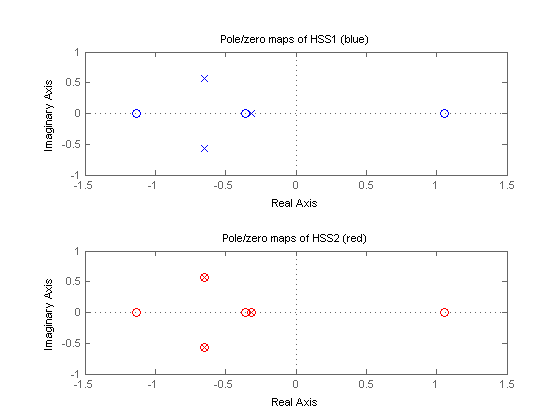
The resulting model HSS2 has twice the order of HSS1, as confirmed by
[size(HSS1,'order') , size(HSS2,'order')]
ans =

     3     6
This happens because 6 is the generic order of 2x2 transfer matrices with denominator of degree 3. The reduced order 3 is an "anomaly" due to exact pole/zero cancellations (look for x's inside o's in the pole/zero map).
You can use the command MINREAL to eliminate cancelling pole/zero pairs and recover a 3rd-order, minimal state-space model from HSS2:
HSS2_min = minreal(HSS2);
3 states removed.
subplot(211)
pzmap(HSS1,'b')
title('Pole/zero maps of HSS1 (blue)')
subplot(212)
pzmap(HSS2_min,'r')
title('Pole/zero maps of HSS2\_min (red)')
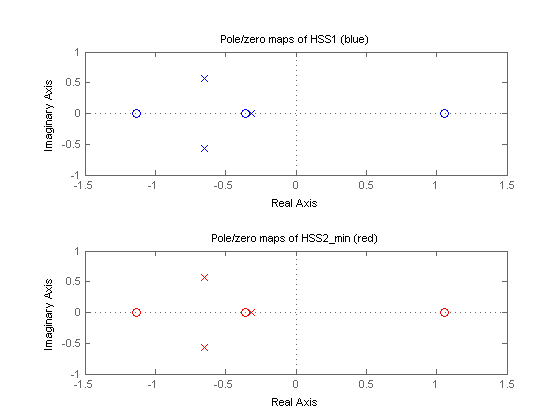
Since extracting minimal realizations is numerically challenging, it is best to avoid creating nonminimal models in the first place. (see also the "Model Interconnections" topic).
Moral: Don't abuse conversions, and stick with the state-space form for all computations.