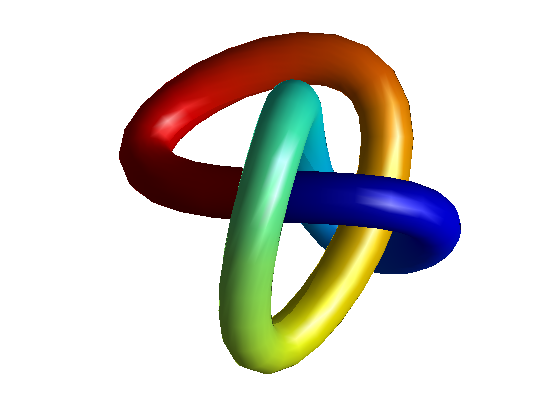
Compute the parametric representation of tube-like surfaces and display the tube with SURF.
Original code by Rouben Rostamian, March 1991. Modified from Titan MATLAB to MATLAB V4.0 by Cleve Moler, September 1991.
% Number of grid points in each (circular) section of the tube.
m = 20;
% Number of sections along the tube.
n = 60;
% Radius of the tube.
R = 0.75;
% Symmetry index.  Try q=floor(n/3) (symmetric) or q=floor(n/4)
q = floor(n/3);

% Do not change this!
t = (0:n)/n;
% The generating function f0 must be 1-periodic.
% f1 and f2 are the first and second derivatives of f0.
a = 2; b = 3; c = 1.5;
q1=2; q2=4;
f0 = sin(q1*pi*t) + a*sin(q2*pi*t) - ...
    b*cos(4*pi*t)/2 + c*sin(6*pi*t);
f1 = (q1*pi)*cos(q1*pi*t) + a*(q2*pi)*cos(q2*pi*t) + ...
    b*(4*pi)*sin(4*pi*t)/2 + c*(6*pi)*cos(6*pi*t);
f2 = -(q1*pi)^2*sin(q1*pi*t) - a*(q2*pi)^2*sin(q2*pi*t) + ...
    b*(4*pi)^2*cos(4*pi*t)/2 - c*(6*pi)^2*sin(6*pi*t);
% Extend f periodically to 2 period-intervals:
f0 = [ f0(1:n) f0(1:n) ];
f1 = [ f1(1:n) f1(1:n) ];
f2 = [ f2(1:n) f2(1:n) ];

% [x10;x20;x30] is the parametric representation of
% the center-line of the tube:
x10 = f0(1:n+1);
x20 = f0(q+1:q+n+1);
x30 = f0(2*q+1:2*q+n+1);

% [x11;x21;x31] is velocity (same as tangent) vector:
x11 = f1(1:n+1);
x21 = f1(q+1:q+n+1);
x31 = f1(2*q+1:2*q+n+1);

% [x12;x22;x32] is acceleration vector:
x12 = f2(1:n+1);
x22 = f2(q+1:q+n+1);
x32 = f2(2*q+1:2*q+n+1);

speed = sqrt(x11.^2 + x21.^2 + x31.^2);

% This is the dot-product of the velocity and acceleration vectors:
velacc = x11.*x12 + x21.*x22 + x31.*x32;

% Here is the normal vector:
nrml1 = speed.^2 .* x12 - velacc.*x11;
nrml2 = speed.^2 .* x22 - velacc.*x21;
nrml3 = speed.^2 .* x32 - velacc.*x31;
normallength = sqrt(nrml1.^2 + nrml2.^2 + nrml3.^2);

% And here is the normalized normal vector:
unitnormal1 = nrml1 ./ normallength;
unitnormal2 = nrml2 ./ normallength;
unitnormal3 = nrml3 ./ normallength;

% And the binormal vector ( B = T x N )
binormal1 = (x21.*unitnormal3 - x31.*unitnormal2) ./ speed;
binormal2 = (x31.*unitnormal1 - x11.*unitnormal3) ./ speed;
binormal3 = (x11.*unitnormal2 - x21.*unitnormal1) ./ speed;

% s is the coordinate along the circular cross-sections of the tube:
s = (0:m)';
s = (2*pi/m)*s;

% Each of x1, x2, x3 is an (m+1)x(n+1) matrix.
% Rows represent coordinates along the tube.  Columns represent coordinates
% in each (circular) cross-section of the tube.

xa1 = ones(m+1,1)*x10;
xb1 = (cos(s)*unitnormal1 + sin(s)*binormal1);
xa2 = ones(m+1,1)*x20;
xb2 = (cos(s)*unitnormal2 + sin(s)*binormal2);
xa3 = ones(m+1,1)*x30;
xb3 = (cos(s)*unitnormal3 + sin(s)*binormal3);
color = ones(m+1,1)*((0:n)*2/n-1);

x1 = xa1 + R*xb1;
x2 = xa2 + R*xb2;
x3 = xa3 + R*xb3;
surf(x1,x2,x3,color);
shading interp;
light
lighting gouraud % 'lighting phong' will use zbuffer, slower
view(2)
axis equal off
axis vis3d % for smooth rotate3d