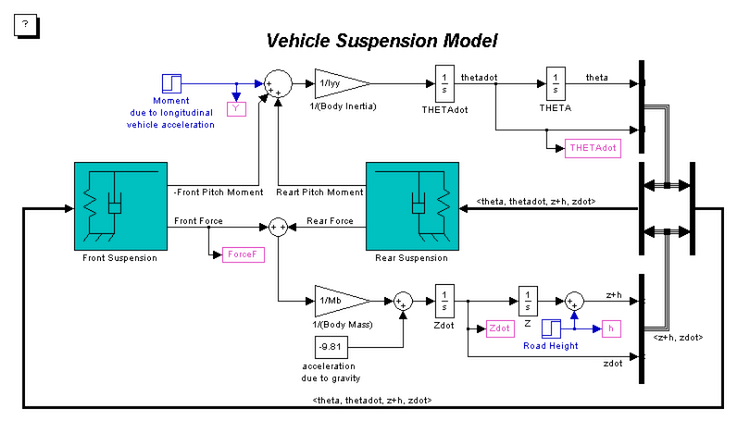
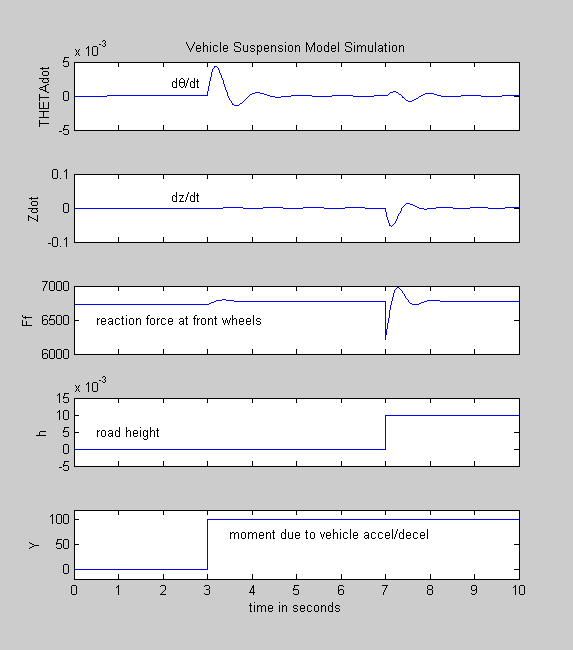
This example describes a simplified half-car model that includes an independent front and rear vertical suspension as well as body pitch and bounce degrees of freedom. We provide a description of the model to show how simulation can be used for investigating ride and handling characteristics. In conjunction with a powertrain simulation, the model could investigate longitudinal shuffle resulting from changes in throttle setting.
We model the front and rear suspension as spring/damper systems. A more detailed model would include a tire model as well as damper nonlinearities such as velocity-dependent damping with greater damping during rebound than compression. The vehicle body has pitch and bounce degrees of freedom, which are represented in the model by four states: vertical displacement, vertical velocity, pitch angular displacement, and pitch angular velocity.
A detailed review of the equations used in this design can be found in the white paper Using Simulink and Stateflow for Automotive Examples. Please note that this paper is based on an older version of Simulink and does not use all the newest block diagramming features in the current version of Simulink.