The Census of Marine Zooplankton (CMarZ) is a field project
of the Census of Marine Life (see www.CoML.org).
CMarZ is working toward a taxonomically comprehensive assessment
of biodiversity of animal plankton throughout the world ocean. The
project goal is to produce accurate and complete information on
zooplankton species diversity, biomass, biogeographical distribution,
genetic diversity, and community structure by 2010. Our taxonomic
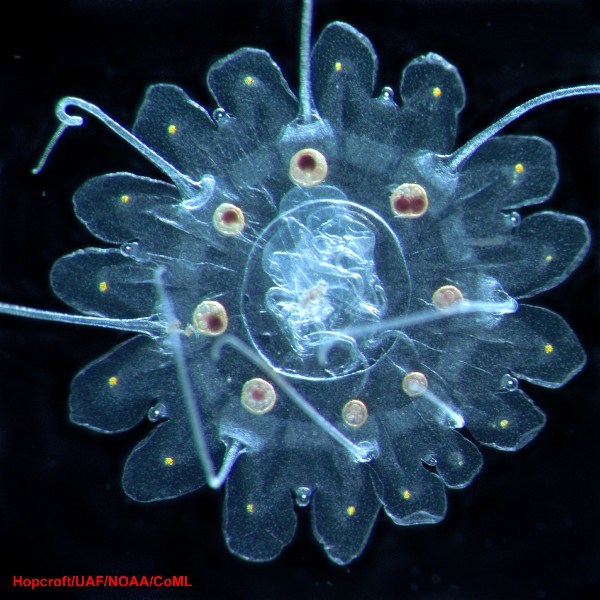
focus is the animals that drift with ocean currents throughout their
lives (i.e., the holozooplankton, Fig. 1). This assemblage currently
includes ~6,800 described species in fifteen phyla; our expectation
is that at least that many new species will be discovered as a result
of our efforts. The census encompasses unique marine environments
and those likely to be inhabited by endemic and undescribed zooplankton
species.
Sampling zooplankton in many ocean regions is being accomplished
during the first years of the project by coordinating with ongoing,
planned, and proposed programs, surveys, and initiatives. CMarZ is
also making use of existing data and archived zooplankton collections.
The global survey design is being optimized using theoretical and
numerical models in collaboration with the CoML FMAP (Future of
Marine Animal Populations) project. 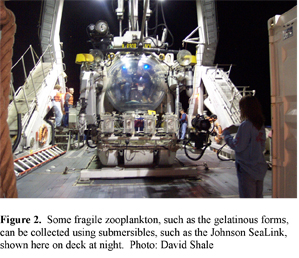 Sampling
systems include traditional nets and trawls, remote detection,
optical sensors, and integrated sensor systems deployed on towed,
remotely-operated, or autonomous vehicles and submersibles (Fig.
2). New sampling methodologies are needed to collect and study rare
and fragile organisms. Molecular analyses include determining
a DNA barcode (i.e., reference DNA sequence) for each species; describing
genetic diversity and structure of populations and species, identifying
cryptic species, and reconstructing their evolutionary histories.
Sampling
systems include traditional nets and trawls, remote detection,
optical sensors, and integrated sensor systems deployed on towed,
remotely-operated, or autonomous vehicles and submersibles (Fig.
2). New sampling methodologies are needed to collect and study rare
and fragile organisms. Molecular analyses include determining
a DNA barcode (i.e., reference DNA sequence) for each species; describing
genetic diversity and structure of populations and species, identifying
cryptic species, and reconstructing their evolutionary histories.
CMarZ has established regional centers for scientific leadership,
planning and implementation of field activities, and raising funding.
Three project offices have been established: in N. America (USA),
Europe (Germany), and Asia (Japan). The CMarZ
Steering Group reflects the project’s geographic,
taxonomic, and disciplinary diversity; guides scientific and technical
development; and ensures close coordination with other CoML field
projects.
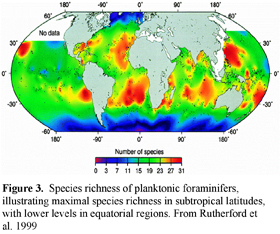
Important outcomes for CMarZ will be more complete knowledge of
biodiversity hotspots and unexplored ocean regions, new understanding
of the functional role of biodiversity in ocean ecosystems, and
better characterization of global-scale patterns of zooplankton
biodiversity in the world ocean (Fig. 3). CMarZ will result in new
sampling, data gathering, and data visualization technologies for
biological oceanographers, allowing collection of the tiny, fragile,
and/or deep-living organisms that have been historically under-sampled
or missed altogether. Practical deliverables for CMarZ relate to
the need for ecosystem-based fisheries and ocean management, including:
identification of invasive species, accurate estimates of species
biodiversity, and rapid assessment of ecosystem health.
 Building new capacity and expertise for taxonomic analysis of zooplankton
groups is needed for species-level identification of all zooplankton
groups. Informal education outcomes include greater public appreciation
for the value of marine biodiversity. Dissemination of information entails web pages, presentations, and printed materials for
students, researchers, and general audiences, as well as peer-reviewed
scientific publications. CMarZ will contribute to the CoML Education
and Outreach Network, and will identify partners to assist with
public education and communications activities. A distributed database
– fully integrated with and searchable from the Ocean Biogeographical
Information System (OBIS) portal – is being created, with species-level,
specimen-based, geo-referenced entries.
Building new capacity and expertise for taxonomic analysis of zooplankton
groups is needed for species-level identification of all zooplankton
groups. Informal education outcomes include greater public appreciation
for the value of marine biodiversity. Dissemination of information entails web pages, presentations, and printed materials for
students, researchers, and general audiences, as well as peer-reviewed
scientific publications. CMarZ will contribute to the CoML Education
and Outreach Network, and will identify partners to assist with
public education and communications activities. A distributed database
– fully integrated with and searchable from the Ocean Biogeographical
Information System (OBIS) portal – is being created, with species-level,
specimen-based, geo-referenced entries.
For further information, download the PDF Census
of Marine Zooplankton (CMarZ) Science Plan. [2.5MB]
 Project
Description
Project
Description