|
|
|
| |
|
|
Monoculus finmarchicus (Gunnerus, 1770)
| Cetochilus septentrionalis (Goodsir, )
Calanus spitsbergensis (Kröyer, )
Calanus quinqueannulatus (Kröyer, )
Calanus tonsus (Brady, 1883)
Hierarchy:
Retrieved [2006-05-22], from | | | Kingdom Animalia -- animals, animales, animaux | | Phylum Arthropoda arthropods, artr%C3%B3podos, arthropodes | | | Subphylum Br%C3%BCnnich, 1772 -- crustaceans, crust%C3%A1ceos, crustac%C3%A9s | | | Class Maxillopoda Dahl, 1956 | | | Subclass Copepoda Milne-Edwards, 1840 --copepods, cop%C3%A9podos, cop%C3%A9podes | | | Infraclass Neocopepoda Huys & Boxshall, 1991 | | | Superorder Gymnoplea Giesbrecht, 1882 | | | Genus Calanus Leach, 1816 | | | Species finmarchicus Gunner, 1765 |  Return to top Return to top
| |
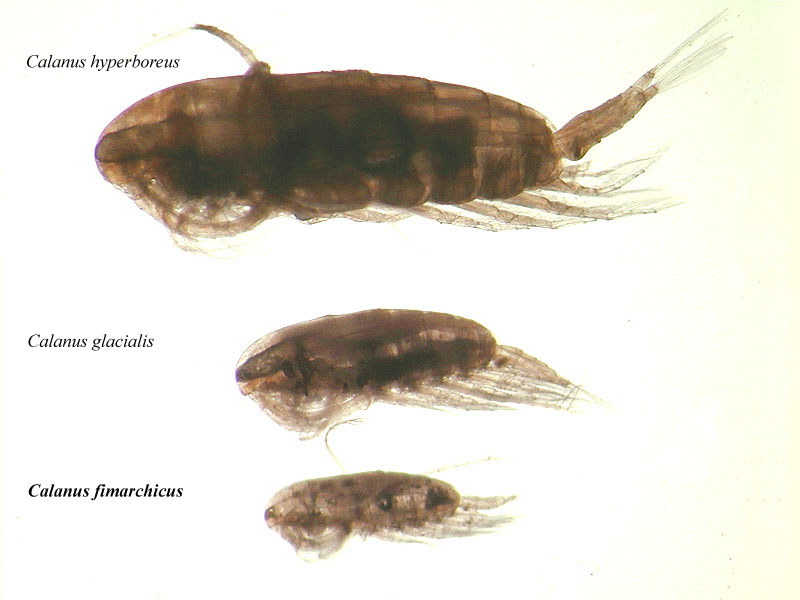
A calanid copepod of the genus Calanus. In the North Atlantic, C. finmarchicus can be confused with congeners C. helgolandicus and C. glacialis which both overlap in size and range with C. finmarchicus. It has also been mistaken for C. marshallae which resides in the northern Pacific Ocean. C. finmarchicus does not occur in the Pacific Ocean. To date, C. finmarchicus specimens found in the Pacific have been incorrectly identified C. marshallae. Another species of Calanus overlapping in range with C. finmarchicus is C. hyperboreus, a significantly larger species. Adult C. finmarchicus can be distinguished from C. helgolandicus, chiefly by: - the less elongated outer ramus of the left last leg in the male.
- the female 5th leg basipod of C. helgolandicus has a curved interior margin.
- the more evenly rounded frontal part of the female head.
- the longer caudal rami.
- larger size than C. helgolandicus (female prosome 1.98-2.80mm, Fleminger & Hulsemann, 1977)
- the pore signature pattern of integumental organs as described by Fleminger and Hulsemann (1977).
- the geographical range of C. helgolandicus is centered in the eastern N. Atlantic and warmer waters of the western N. Atlantic
Adult Calanus finmarchicus can be distinguished from C. glacialis, and C. marshallae by: - the less elongated outer ramus of the left 5th leg in the male.
- the female head shape
- the female 5th leg basipod of C. glacialis has a curved interior margin
- smaller size than C. glacialis (prosome 3.36-4.08 mm, Fleminger & Hulsemann, 1977)
- shape of posterolateral margin of the fifth thoracic segment Fleminger & Hulsemann, 1977)
- shape of ventral surface of genital segment Fleminger & Hulsemann, 1977)
- the pore signature pattern of integumental organs as described by Fleminger and Hulsemann (1977).
- the photoreceptor of C. marshallae is very large (Fleminger & Hulsemann, 1977)
- the geographical range of C. glacialis is more northerly than finmarchicus in the western N. Atlantic and also occurs in the polar waters of the N. Pacific. C. marshallae has been identified only in the N. Pacific
- smaller length than C. glacialis (female prosome: 3.36-4.0, Fleminger & Hulsemann, 1977)
Adult Calanus finmarchicus can be distinguished from C. hyperboreus by: - the fifth posterolateral margin of the fifth thoracic segment has pointed tips on male, female, C5 and C4
- smaller length than C. hyperboreus. Female prosome: 5.9-7.4 (Hirche, 1997), total length: 7-10mm (Wilson, 1932), male: total length: 6-7mm (Wilson, 1932)
|
|
|
Size:
|
| |
Prosome length:
female; 1.86 mm (Murphy & Cohen, 1978) - 3.28 mm (Frost, 1974)
male; 2.08 mm (Frost, 1974) - 3.16 mm (Frost, 1974)
Total length:
female; 2.42 mm (Frost, 1974) - 4.21 mm (Frost, 1974)
male; 2.57 mm (Frost, 1974) - 3.98 mm (Frost, 1974)
|
|
Distribution:
|
| |
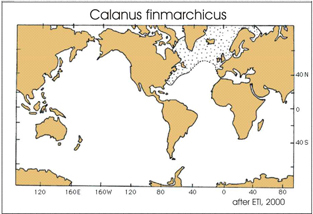
Sub-arctic and temperate regions of North Atlantic Ocean.
Depth distribution: epipelagic (0-500 m), or mesopelagic (500-1000 m).
|
|
Ecology:
|
| |
Copepodite stage 5 enters diapause for the fall and early winter, remaining at depth until ready to molt into adult forms and begin reproduction.
Additional Comments
|
|
Genetics:
|
|
References, Citations, Links to Literature:
|
Modification History:
History Link
This information was compiled and submitted by N. Copley. |
|
| Gallery
 | Photo: Rebecca Jones
 | |
|
Distribution Map
|
Specimen Data Map from OBIS
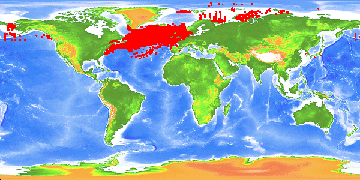
| OBIS stored distribution - Calanus finmarchicus (data source from NODC WOD01 Plankton Database (NODC), ZooGene, Southampton Oceanography Center Discovery Collections Midwater Database (SOC), SAHFOS_CPR_ZOOPLANKTON, Taxonomic Information System for the Belgian coastal area (EUROBIS), Gwaii Haanas Invertebrates (Canadian Regional Node) Larger image |
|
|
|
Species Page Version 1.11
|