INVESTIGATORS:

Peter J.S. Franks
Marine Life Research Group
Scripps Institution of Oceanography
University of California, San Diego
La Jolla, CA 92093-0218
pfranks@ucsd.edu

Changsheng Chen
Department of Marine Sciences
University of Georgia
Athens, GA 30602-2206
chen@whale.marsci.uga.edu

GRANT PERIOD:  July 1, 1993 - June 30, 1996
An unexpected spin-off of this study was a model examining the formation of thin (10's of cm) layers of phytoplankton (Franks, 1995). This model supported the hypothesis that these thin layers could form by the interaction of along-isopycnal patchiness of phytoplankton with vertical shear caused by near-inertial waves. The thickness and duration of the layers could be predicted from the model given the initial horizontal scale of the patchiness and the shear. One significant prediction of the model, that the layers should be inclined across isopycnals, is quite testable, and is being explored in field programs.
A significant portion of this work was devoted to developing a fully coupled primitive-equation/mixed-layer/ecosystem model to study phytoplankton production at fronts. A slab mixed-layer model was coupled to the Franks et al. (1986) nutrient- phytoplankton-zooplankton (NPZ) model. In a study of the effects of transient wind events on phytoplankton production at fronts (Franks and Walstad, submitted ms.), we found that significant patchiness of phytoplankton could develop around and within a front after a wind event. The formation of patches depended on cross-frontal nutrient gradients and the relationship of the diffuse attenuation coefficient to the depth of the front. Wind forcing excited inertial oscillations at the front, which generated vertical oscillations of the pycnocline. This nutrient-pumping mechanism was found to be less important in the formation of patches than the changes in vertical stratification driven by cross-frontal mixing. Winds forcing an Ekman flux to the cold side of the front suppressed vertical mixing by increasing stratification at the front. Winds with an Ekman flux to the warm side of the front caused enhanced cross-frontal mixing and decreased stratification in the front. These asymmetries were reflected in the phytoplankton patchiness. Strong, persistent patches formed under winds with an Ekman flux to the cold side. Phytoplankton patches tended to erode under winds with Ekman fluxes to the warm side of the front.
This study led to the development of the first fully coupled primitive-equation/mixed-layer/ecosystem model in use in biological oceanography. The results of the study have increased our understanding of the mechanisms influencing phytoplankton patchiness at fronts, and the effects of transient wind events on phytoplankton production in these dynamic physical regimes.
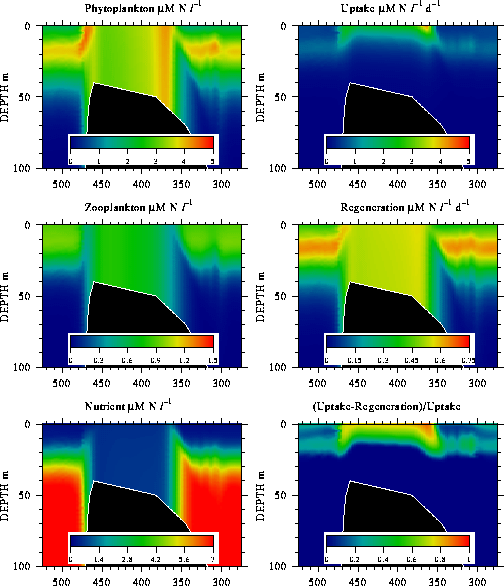
The phytoplankton distributions were mirrored by the dissolved nutrient distributions, which showed very low values on the bank, and a sharp nutricline off the bank. On the flanks of the bank, the nutricline became horizontal, following the tidal fronts. Tongues of higher nutrient concentration could be seen extending toward the surface in the fronts. Inshore of these upward-extending tongues, the low nutrient concentrations extended down the flanks of the bank, reaching ~100 m on the northern flank. Very strong horizontal gradients of dissolved nutrients developed between the waters on top of the bank, and off the bank, particularly below the euphotic zone.
The zooplankton populations, like the phytoplankton and dissolved nutrients, were homogenized on the bank, but their concentration increased from south to north, in the opposite sense of the phytoplankton gradient. The highest zooplankton concentrations were found in the unperturbed waters off the bank, separated from the well-mixed waters on the bank by a region of very low zooplankton concentration.
The highest nutrient uptake rates were found at the surface, in the well-mixed waters of the bank, with tongues of high uptake rates extending downward along the two tidal fronts. Regeneration rates of nutrients were quite low, with maximal rates in the subsurface phytoplankton maximum layers off the bank.
An f ratio can be calculated from the fraction of total production not accounted for by recycled production, i.e. (uptake - regeneration)/uptake. This ratio of production supported by non- regenerated nutrients to total production showed values up to 0.7 at the surface of the southern front. Values of 0.5 - 0.8 were found in the surface waters of the bank and the fronts, with values of 0.1 - 0.2 off the bank. These values suggest a system on the bank which is strongly supported by the flux of new nutrients, surrounded by regions in which production is maintained largely by recycled nutrients. The high values of the f ratio at the surface of the fronts indicates that the phytoplankton patches in these regions are growing largely on nutrients supplied from the aphotic zone by the frontal dynamics.
These results were compared to field data from Georges Bank, and found to be accurate descriptions of the planktonic system. Detailed analysis of the physical-biological couplings in the tidal fronts revealed features that would be difficult to sample in the field due their transient nature and small spatial scale. This study has given us significant new insights into the physical-biological couplings on Georges Bank, and generated a new tool for the exploration of physical-biological interactions in the ocean: the primitive-equation/turbulence-closure/ecosystem model.
The larval fish model is now ready to be incorporated into the two- and three-dimensional physical/ecosystem model described above. We intend to examine the influence of tidally induced biological and physical patchiness on larval development at tidal fronts on Georges Bank (two-dimensional model), and the effects of tidally rectified and wind-driven flows on larval retention on Georges Bank (three-dimensional model).
Franks, P.J.S. 1995. Thin layers of phytoplankton: a model of formation by near-inertial wave shear. Deep-Sea Research I 42:75- 91
Franks, P.J.S. and C. Chen. Plankton production in tidal fronts: a model of Georges Bank in summer. Submitted ms.
Franks, P.J.S. and A. Leising. A metabolic-ecosystem model of larval cod and haddock. In prep.
Franks, P.J.S. and J. Marra. 1994. A simple new formulation for photoadaptation and an application in a wind-driven mixed-layer model. Marine Ecology Progress Series 111:143-153.
Franks, P.J.S. and L.J. Walstad. Phytoplankton response to transient wind forcing at a front. Submitted ms.