U.S. GLOBEC Transitions:
Towards a fully integrated climate-to-fish model
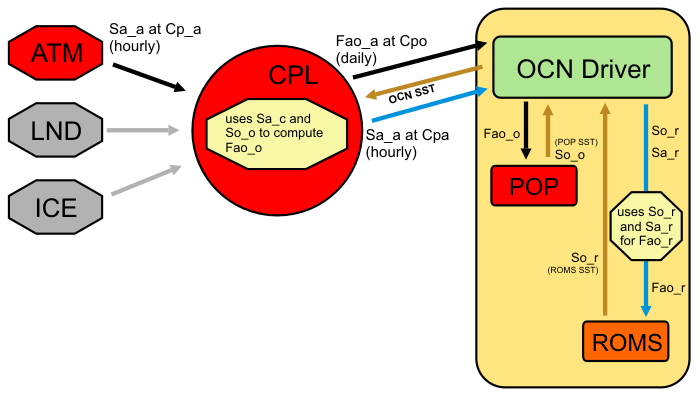
Schematic of the redesigned CCSM data flow. Of note is the new composite ocean
merging a global POP and a regional ROMS ocean.
An effort is underway to couple the Regional Ocean Modeling System,
one of the principle modeling tools in use within U.S. GLOBEC, to the
Community Climate System Model (CCSM) developed and maintained at the
National Center for Atmospheric Research. In large measure due to the
efforts of GLOBEC investigators, the ROMS system now includes multiple
options for ecosystem studies (NPZD-type models , e.g., NEMURO) with a
range of complexities, as well as bio-energetic models (e.g., NEMURO.FISH).
Individual based models for higher trophic levels are also currently being
added to ROMS. The incorporation of ROMS within the CCSM framework thus
offers immediate opportunities for regional downscaling of oceanic
circulation, and the explicit inclusion of ecosystem dynamics.
All the components of the CCSM communicate with each other through
a flux coupler, responsible for mediating fluxes among the components,
as well as for re-gridding and time synchronization of the various
components. The coupler is currently based on MCT (the Model Coupling
Toolkit) with an ESMF (Earth System Modeling Framework) version under
development. As part of the coupling of ROMS to CCSM, a new composite
ocean was developed which couples and synchronizes the global ocean
model (the Parallel Ocean Program) and ROMS. Multiple regional domains
can be simultaneously coupled to the global ocean model, and each
regional patch can have its own ecosystem model.
The following figure shows results utilizing the composite ocean where
the Northeast Pacific is simulated with a high-resolution ROMS nested
within a global POP grid. The regional model, on the right, has a more
realistic representation of the upwelling physics, both in spatial
scale and structure, and upwelling temperature. For this simulation,
only one-way coupling was used, with the global ocean and atmosphere
driving the regional model. The capability for two-way coupling back
to the atmosphere is presently being tested.
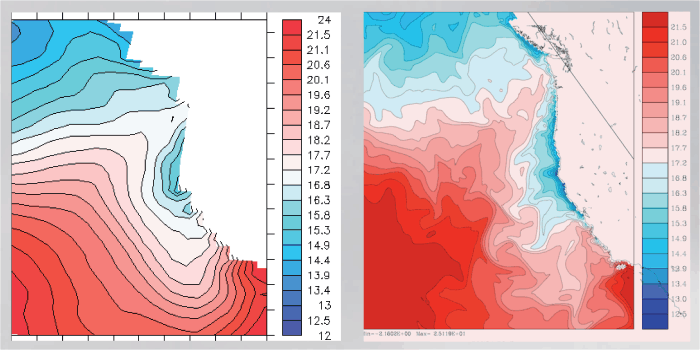
An upwelling event in the Northeast Pacific as represented by POP (left) and ROMS (right).
Overall, our results show that a hybrid climate/regional model can
improve the physical representation in regions of importance to
ecosystems. Our approach allows for flexibility in designing a
simulation with multiple patches at various resolutions. There are
plans for similar coupling of regional atmospheric models using CAM
and WRF, thereby enabling simultaneous regional downscaling of
atmosphere and ocean.