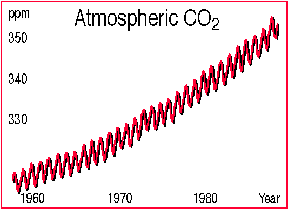
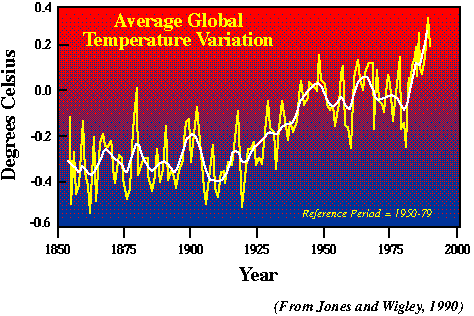
Carbon dioxide and other "greenhouse" gases in the atmosphere absorb heat. The increase in temperature that may result from increasing concentrations of greenhouse gases isn't uniform over Earth's surface, however. It is thought that greenhouse warming will be most pronounced in polar regions in winter, and least in these regions in summer. Warming of tropical and sub-tropical regions would be less seasonal, with summer and winter warming about equivalent.
Large-scale ocean currents, such as the Gulf Stream, are driven by heat and freshwater runoff cycles, and by winds. Changes in atmospheric circulation caused by changes in Earth's heat budget may eventually cause changes in ocean currents. How drastic these changes may be cannot yet be predicted accurately. However, scientists know that during past glacial periods the locations of major ocean currents were significantly different than their present positions. Ocean circulation changes associated with greenhouse warming might produce similar displacements in the future, and cause significant local changes in climate in coastal regions, displacing local species accordingly. If currents shift, an entirely different ecosystem may be the result.
Increased temperatures in polar regions might further affect ocean circulation dynamics through increased freshwater runoff caused by melting of polar ice, displacing offshore coastal fronts and altering nearshore currents. Ocean circulation changes would likely affect species like scallops and cod, which rely on certain currents in their life cycles. For instance, on Georges Bank off the coast of Massachusetts, a physical circulation known as an anticyclonic gyre acts as a "retention center" that enables animal populations to develop and remain there for several months.
Upwelling zones, such as the regions off the west coasts of North and South America, off the northwest and southwest coasts of Africa, and off the Somalian and Arabian coasts, may be altered in character or extent during global warming. These regions, where large amounts of dissolved nutrients are returned to the ocean's surface from its depths, are the site of many of the world's most economically valuable fisheries (for example, sardines, anchovies and hake). Scientists don't yet know whether upwelling will increase or decrease with global climate change. But a reduction or enhancement of upwelling dynamics would greatly affect marine fish populations, and the people who depend upon them for food and their livelihoods.