U.S. GLOBEC: Providing Information for the Future
Beyond the current U.S. GLOBEC Georges Bank effort, future U.S. GLOBEC research is planned for the
eastern Pacific Ocean area, and in the waters surrounding Antarctica.
To support these efforts, new instrumentation is being developed to better assess zooplankton
distribution and abundance. Unlike traditional plankton nets, which allow for observations
at only relatively large scales (hundreds to thousands of meters), new technologies like
high frequency acoustics and optical imaging offer the possibility of making continuous measurements
at very small scales (centimeters to meters). Moored instruments that provide constant observations
are also being used by U.S. GLOBEC researchers.
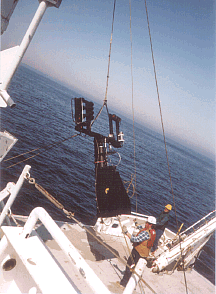 The Video Plankton Recorder, an instrument for observing plankton in real-time,
being deployed. (Photo by Cabell Davis).
The Video Plankton Recorder, an instrument for observing plankton in real-time,
being deployed. (Photo by Cabell Davis).
Further research on the effects of climate change on marine ecosystems is needed to provide
the information necessary for policy decisions in the future. If scientists cannot predict
the effects of particular climate change scenarios and assess their ecological impacts, then
decision-makers cannot plan how to best respond to these changes. The continued existence of
a stable and predictable food supply and environment for sardines, anchovies, cod, haddock, and
other marine species--and ultimately ourselves--may depend on the the knowledge that U.S. GLOBEC
research will provide.