Gear Sensor Specification
To: LENA Noppers
CC: LENA NOPP
From: Gary Williams
Date: July 23, 1998
Re: Net Gear and Onboard Sensors and Budget
The original Word-formatted file is
available.
Here are Clearwater's specifications (Net Gear, an MS Word97
document) for the net gear and onboard sensor systems. We are
using the RS-485 serial data link with command structures and
formats compatible with IMET sensors.
What we are specifying here is what was in our initial proposal: to design and build two sets of equipment for installation
on two vessels. I have gone over our budget and still come up with the same number for the cost of designing, building
and testing the equipment.
I will be on vacation until August 6.
Net Gear and Deck Receiver Schematic.
Net Gear and Deck Transceiver General Specifications.
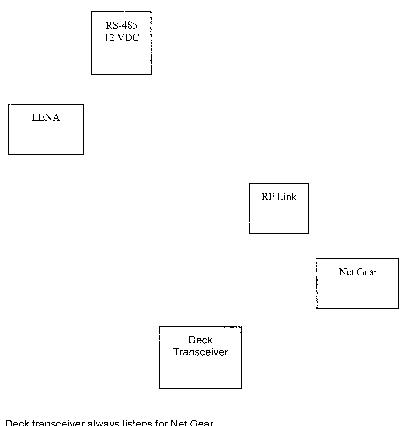
- Deck transceiver always listens for Net Gear.
- RF Link: Linx Technologies TXM-433 and RXM-433 (433MHz); or World Wireless Communications, Inc. LSDR 60
(916.5 MHz)
- Net Gear Parameter List:
- Temperature, 0 - 25 +/- .05 C, 10 bits, linear or non-linear thermistor;
- Depth, 0 - 1000 +/- 2 m, 10 bits, Sensyn 13mm Series 0-2500 psia;
- Record Time, relative: 0 - 7920 seconds (2 sec/record), 12 bits;
- Universal Time stamp, yymmddhhmmss, 12 bytes.
Net Gear and Deck Transceiver Program
- Net Gear Primary Initialization (at power up during manufacture):
- Data Dump bit = 1;
- Initialize RTC to UT.
- Start taking pressure, 1 per 2 sec;
- Stop taking measurements if pressure < 1 m for 32 readings; go into sleep mode; check pressure every 8 seconds.
- When pressure > .1 bar ( equal to 1 meter depth) start logging. Buffer 32 samples, commence recording when depth
>10 meters; data dump bit set to 0; set time stamp: yymmddhhmmss.
- Data record stop: Record = 7920 (4.4 hours); or when depth is <5m for 8 records.
- When depth < 5 meters and data dump bit = 0:
- Net Gear sends request for data dump to Deck Transceiver;
- Data dump commences when communication link established between Net Gear and Deck Transceiver.
- Net Gear sets data dump bit=1 when cast data sent; turns off transmitter and receiver.
- When data dump complete, Deck Transceiver send data ready message to LENA, #NGRDY. Ready messages sent
1/sec until acknowledged with data query.
- When queried with #NG01C, Deck Transceiver sends data to LENA. Message format (ASCII):
- Date/time start header:yymmddhhmmss <CR> (eg. 980720132756 = July 13, 1998 13:27:56);
- Data record: mmmmtt.t<CR> (eg. 011310.5 = 113 meters 10.5 C) followed by line feed;
- Last record terminated with EOF.
- When data sent, Net Gear commences checking pressure every 8 seconds.
- Returns to step 2.
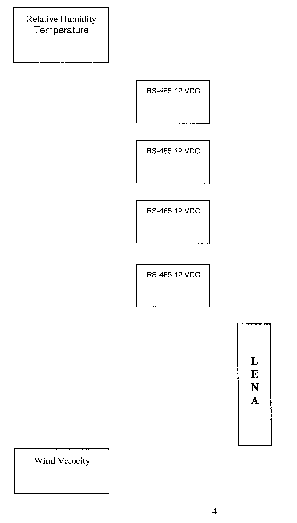
Onboard
System
General Specifications
- Data interface to LENA: RS-485.
- Power: 12 VDC, 50 mA.
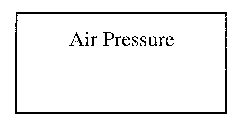
- Time Stamp: supplied by LENA.
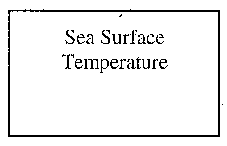
Additional Comments from Joe Novello
- The title of document should be "gear sensor specification" to avoid
confusion on bus spec.
- Some vessel tow more than one net and also tow side by side. You may want
to have each gear sensor have its own RF link address to avoid cross talk
between vessel and gear sensors.
- When the drag is set out it may change depth and sensor will see higher
water pressure due to sensor being dragged through water. Placement of
pressure sensor is important. Also use of pressure data to end a record cycle
may unreliable during set out period. ( i.e., gear could go down then back up
in short 1 min. to 10 min. intervals)
Ending a record cycle only after buffer is full or data has been retrieved by
main processor may be more flexible solution.
- It is not clear how long a record cycle can be. With ~4000 records at 2
sec. per record, I get ~ 2 hours. 5 hours (~) of record is a better higher
limit.
Also with a vessel speed less than 5 miles/hour when towing, the distance at
every 2 seconds may be overkill.
Last modified: July 29, 1998